The Dam That Didn't Fall, Yet a Wave Crossed It | Vajont Dam True Story

🎬 The video premieres soon
It was one of the tallest dams in the world, and it did not fail. The concrete wall stood almost intact. Yet on the night of 9 October 1963, a wave about 250 metres high crossed its top and fell on the Piave Valley below. What had the engineers seen, and what had they ignored? This documentary follows the Vajont Dam from its 1920s conception to its construction, early landslides, model experiments, ignored warnings, the night of the catastrophe, the rescue, the political fight over blame and the long legal aftermath. Discover how a mountain nicknamed the Walking Mountain became the centre of one of Europe's most debated engineering disasters, and what lessons it still holds.
Chapter 1The Night the Lake Jumped the Dam
On the night of 9 October 1963, in a valley in northern Italy, the Vajont Dam reservoir lay beneath Monte Toc. It was still in the early stages of filling. At 10:39 pm, an entire slope of Monte Toc gave way. Roughly 260 million cubic metres of earth, rock and trees plunged into the lake.
Disaster followed. About 50 million cubic metres of water passed over the top of the dam, in a wave 250 metres high. Below, in the Piave Valley, lived towns such as Longarone, and the wave was heading straight for them. According to official figures, 1,917 people were killed, though some estimates run as high as 2,500. We tell this story with respect for every affected family.
The surprising fact is that the dam itself remained largely intact. Only about 1 metre of masonry at the top was swept away, and the main structure still stands today. So the question is this: if the dam did not fall, how did such a huge disaster happen? What did the engineers get wrong? Why was the mountain trusted? And when warning signs were there, who was held responsible?
In this article we follow the whole story in order, from the plans of the 1920s to the courtroom. Everything is based on sources. We begin with the mountain that locals called The Walking Mountain. Even its name was not a good sign.
Chapter 2A Giant Dam Under a Rotten Mountain
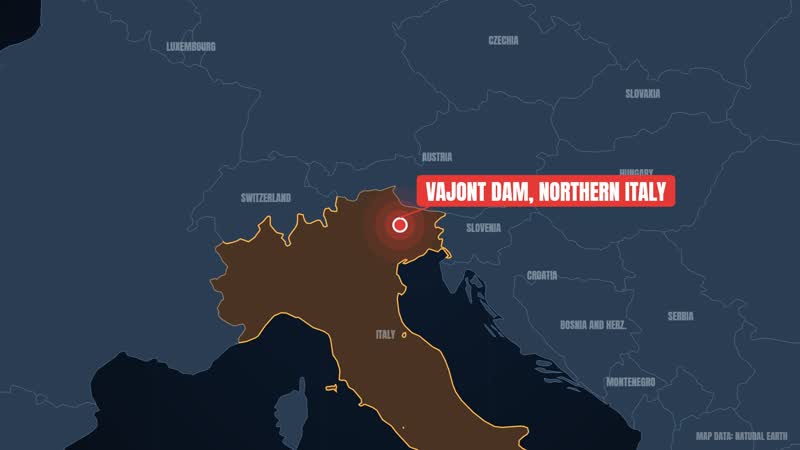
The Vajont Dam stands in the Erto e Casso valley in northern Italy, about 100 kilometres from Venice, in the narrow gorge of the Vajont river. It is 262 metres high, roughly 860 feet, which places it among the tallest dams in the world.
It was built by Società Adriatica di Elettricità, known as SADE, which held a monopoly on electricity supply and distribution in north-eastern Italy. SADE's owner was Giuseppe Volpi di Misurata, who had served for several years as Mussolini's finance minister.
The project was not new. The idea dates to the 1920s, when demand for electricity and industrial growth were rising fast in Italy. The aim was to use the waters of the Piave, Maè and Boite rivers. Vajont was to be the centre of a large water-management system, bringing in water from nearby valleys and high artificial basins, with concrete pipes and pipe bridges dozens of kilometres long considered for the purpose. The dam was not just a wall but part of a large system of power and industry.
The dream was not approved at once. After Mussolini's fall in World War II, the turmoil held the project back, and it was finally approved on 15 October 1943. After the war, in the 1950s, post-fascist governments also kept SADE's monopoly in place.
Now consider the mountain in whose shadow the dam was built. Monte Toc lies on the border between Veneto and Friuli-Venezia Giulia. Locals called it The Walking Mountain because landslides kept occurring on it. Its name is linked to the Friulian word patoc, meaning rotten or soggy. So on one side stood one of the world's tallest dams, and on the other a mountain whose very name hinted at weakness.
The dam's engineer was Carlo Semenza, born in 1893 and died in 1961. The dam was built between 1957 and 1960. Today it is disused and produces no electricity, but a night in 1963 made it known across the world. Was such a huge wall really safe in front of that mountain? The answer begins in the next section.
Chapter 3Building Despite the Warnings
Construction began in 1957. Before that, SADE needed land, and the communities of Erto and Casso lived in the valley. SADE's monopoly had been confirmed in the 1950s. It bought land even though the Erto and Casso communities opposed it, and that opposition was put down with the help of the government and police. So the voices of local people were left behind at the very start of the story.
SADE's position was that the geology of the gorge had been studied, including an analysis of earlier landslides. According to the company, the mountain was considered stable enough. On paper, everything looked fine.
Then came 1959. While a new road was being built toward Monte Toc, shifts and fractures were noticed in the ground, and further studies were made. Three experts separately told SADE that the whole slope of Monte Toc was unstable. In their view, if the lake were filled, the rising water would increase instability and the mountain could fall into the basin. This is important: three experts warned before the lake was filled, so the danger was visible in advance.
What did SADE do? According to sources, the company paid no attention. Construction continued and the dam was completed in October 1959. In February 1960, SADE received permission to fill the lake. The wall had a volume of 360,000 cubic metres and could hold back 168.7 million cubic metres of water.
Sources also say that ENEL and the Italian government hid reports describing Monte Toc as unstable, and that many warnings, danger signs and negative assessments were ignored. We will look at these one by one.
Meanwhile, the people of Erto and Casso lived in the valley under that mountain. For them it was not just an engineering project. This contrast is the heart of the story: a plan for progress and electricity on one side, and a danger hidden in the mountain on the other. Permission had been given, but did the mountain stay quiet? The next section covers the first signs and the journalists who ended up in court.
Chapter 4The First Signs: Landslides and Journalists in Court
The mountain did not stay quiet. On 22 March 1959, while Vajont was still under construction, a landslide struck the nearby Pontesei Dam. It raised a wave 20 metres high and killed one person. It was a serious event, but the story was only beginning. In the summer of 1960, small landslides and ground movement were noticed around Monte Toc, and people could see it happening.
How would these signs be answered? The Italian government, instead of attending to them, prosecuted some journalists who were reporting the problems. The charge was undermining social order. One name in this story is Tina Merlin, whose articles in the newspaper l'Unità discussed the attitude of SADE's management. L'Unità was the paper of the Italian Communist Party, the PCI, and after the disaster it was the first to point a finger at management and the government.
Then came 4 November 1960. The water level was about 190 metres, while the plan was for it to reach 262 metres. On that day a landslide of about 800,000 cubic metres fell into the lake. It was much smaller than the later one, but it was a major warning. SADE stopped filling and lowered the water level by about 50 metres. Work began on an artificial gallery in the lake in front of Monte Toc, so that if further landslides split the lake in two, the basin would still be usable. This means more landslides were expected. That is notable: SADE had said the mountain was stable enough, yet its own planning now included more landslides.
In October 1961 the gallery was finished and SADE began refilling the reservoir, this time under monitoring. Then came April and May 1962. The water level was 215 metres, and people in Erto and Casso reported five tremors, grade five on the Mercalli scale. SADE played down their importance. After this, it was even allowed to fill the reservoir to its maximum level.
Think about it: cracks in the ground in 1959, a landslide in 1960, tremors in 1962. At every step there was a sign. Until now it was all happening on paper and in reports. But SADE had one more question: if a landslide did come, how big would the wave be? To find out, a small model of the lake was built. The next section tells that story. Did it tell the truth?
Chapter 5The Model That Gave Comfort
SADE wanted to know what would happen if part of Monte Toc fell into the lake, so a physical hydraulic model was built at a scale of 1:200, two hundred times smaller than the real thing. It was set up at SADE's hydroelectric plant at Nove. The tests were entrusted to two professors, Ghetti and Marzolo, of the Institute of Hydraulics at Padua University. SADE paid for them, and the work was done under the supervision of the company's study office.
The experiments came in two series: the first in August and September 1961, the second from January to April 1962. The first series aimed to improve the model. The first test took place on 30 August 1961, using a sheet laid on a wooden board tilted at 30 degrees, with gravel for the falling mass. A problem then appeared: the real natural landslide could not be recreated in the model, so the sliding surface was changed and made of masonry. The second series had 17 tests, from 3 January to 24 April 1962, and this time the gravel was bound with hemp nets and ropes.
An important point is that this study was meant to test hydraulic effects on the dam and the shores, not to repeat the natural landslide. Ghetti's final report split the rise in water into two parts: a static increase, the lasting rise in lake level as the landslide sinks, and a dynamic boost, the temporary movement of waves. According to the report, this depended almost entirely on the landslide's speed and very little on its volume.
The report of 3 July 1962 said that predicting the landslide from geology was very uncertain, and that the dam faced no static danger. Its conclusion was that with the reservoir at 700 metres, in the worst case a little over 2,000 cubic metres per second would pass over the dam. At 670 metres, even the fastest landslide would produce only a very limited wave. So the 700-metre level was treated as safe in this report.
The calculation for a full reservoir was different. If the landslide fell in only 1 to 1.30 minutes, the overflow could be about 30,000 cubic metres per second, and the wave 27.5 metres high. If that time were doubled, the overflow would be under 14,000 and the wave about 14 metres.
In July 1962, SADE's own engineers said that if the water was 20 metres or less below the crest, a wave could pass over the dam. SADE therefore decided to keep the water 25 metres below the crest, only 5 metres away from that limit. Later some people criticised the simulation as approximate. In reality, the whole landslide was over in just 45 seconds.
So did the model understate the danger, or was the problem the movement of the real mountain? In the next section, the countdown on Monte Toc begins.
Chapter 6Countdown on Monte Toc
Almost a year had passed since Ghetti's report, and now the real mountain was speaking in place of the model. From here time moves fast. In 1962 the dam was nationalised, and in March 1963 it passed to ENEL, the newly formed state electricity body. The owner changed, but the mountain stayed the same.
Then came the summer. The reservoir was almost full, and the local population repeatedly reported landslips, tremors and ground movement. In 1959 three experts had separately said that rising water would increase the mountain's instability. Now the water was close to its final limit. Locals were worried. For them this was no theoretical debate, and they kept reporting everything they felt.
On 15 September 1963 the whole side of the mountain slid 22 centimetres. This was no small moment, because the movement now involved the entire slope. Eleven days later, on 26 September, ENEL decided to empty the basin gradually and bring the water down to 240 metres, to keep damage low if a landslide came. But lowering the water did not slow the mountain.
Look at the creep numbers. Before the landslide, downward movement of the regolith was 1.01 centimetres per week. In September it rose to 25.4 centimetres per day: from 1 centimetre a week to 25 centimetres a day. In the same period, September rains further saturated the caverns in the limestone layers, which was bad news for the geology. By early October, the fall of Monte Toc's slope seemed inevitable. It moved about 1 metre in one day, and the day before the disaster the movement was measured at 1 metre. What began as centimetres per week had become metres per day.
On the evening of 9 October, engineers gathered at the site. They saw trees falling and rocks rolling toward the reservoir, in the very place where the landslide was expected. It was an alarm bell. A big landslide seemed close, and little time was left.
Why did ENEL's effort come too late? The size of the landslide had been underestimated, and when the decision to lower the water was made, disaster was almost upon them. According to sources, ENEL and the Italian government hid reports and rejected evidence that described Monte Toc as unstable. One question remains: what happened at 10:39 pm that night? In the next section we look at those 45 seconds.
Chapter 7Forty-Five Seconds
It was 10:39 pm. A landslide about 2 kilometres long broke away from the northern part of Monte Toc and rushed down toward the lake. It carried about 260 million cubic metres of trees, earth and rock. Its speed is given as up to 110 km/h, while another source says 90 km/h. The debris reached the water's surface in only 20 seconds, and within 45 seconds the landslide had stopped, with the whole Vajont reservoir filled. The impact also produced a seismic shock. In about 25 seconds, 115 million cubic metres of water were displaced.
Where would that water go? The impact created three large waves, each with its own direction. The first rose and reached the houses of Casso, then fell back onto the landslide and moved on, digging out the basin of the Massalezza pond. The second went toward the shores of the lake. Its washout action destroyed several areas in the municipality of Erto e Casso and damaged small lakefront villages.
The third wave was the most significant. It held about 50 million cubic metres of water, which rose over the dam's edge and fell into the narrow valley below. This wave is reported to have been 250 metres high. Even so, the dam's main structure survived and still stands. Only about 1 metre of masonry at the top was swept away, and the roadway on the left side also broke. The dam was saved, but the valley below was not. Remember that the dam wall had a volume of 360,000 cubic metres and could hold back 168.7 million cubic metres of water.
The water then reached the rocky coastal strip of the Piave Valley, picking up a great deal of debris on the way. Debris and water destroyed the southern part of Longarone. Only the town hall survived, and the houses north of it were also destroyed. Along with Longarone, Pirago, Rivalta, Villanova and Faè were destroyed. Near Castellavazzo, Codissago and the villages of Erto e Casso were also largely ruined. Below the dam, the land turned into a flat plain of mud, and an impact crater 60 metres deep and 80 metres wide formed there.
One distinction matters. The lakeside villages were affected by the displacement wave, while the valley below the dam was hit by an overtopping flood. On one side were the waves within the lake, and on the other the water coming over the dam. The destruction arrived by different routes. Ghetti's report had considered the fastest landslide to take 1 to 1.30 minutes. That night the entire landslide had stopped within 45 seconds.
So far we have seen the speed of the destruction. But what was the morning like in Longarone? In the next section we look at the rescue, the blame and the fight for the truth.
Chapter 8Rescue, Blame and the Fight for the Truth
Firefighters from Belluno set out on word of the Piave's rising level, but the road from the valley had been completely washed away beyond one point. Firefighters coming from Pieve di Cadore reached Longarone. They were the first to understand what had happened, and they passed the news on.
At 5:30 am on 10 October the first soldiers of the Italian Army arrived, mostly Alpini. They searched for missing people by digging with their hands. 850 firefighters from 46 Provincial Commands also joined the rescue, with divers, land teams, helicopter teams and many vehicles and supplies. Eight personnel of the Nucleo Sommozzatori of Genoa also worked there. They searched the basin in front of the Busche Dam and also watched over 61 cyanide drums. Of roughly 2,000 bodies, only 1,500 people were found, and half of them could not be identified.
The depth of the grief is beyond words. Official figures give 1,917 victims, while estimates go up to 2,500. One source gives 1,918 bodies, of which 1,450 were in Longarone. The dam itself largely survived, but in the valley below about 350 families lost every member. Most survivors also lost their homes.
Immediately after the disaster, the government, politicians and public authorities called it an unexpected and unavoidable natural event. The press debate was also heavily shaped by politics. L'Unità was the first paper to raise its voice against the attitude of management and government, and it had already printed Tina Merlin's articles. Indro Montanelli, the most influential journalist of the time, attacked l'Unità and denied any human responsibility. Christian Democracy's campaign targeted l'Unità and the PCI, accusing them of political profiteering and linking the disaster only to natural causes. La Domenica del Corriere and a national campaign poster called l'Unità and the PCI jackals, speculating on grief and on the dead.
On one side, Giovanni Leone promised justice. On the other, a few months after leaving the premiership he became head of SADE's team of lawyers. According to sources, this team got the compensation for survivors reduced considerably and had payment cancelled for at least 600 victims.
Then came the trial. The judges of the preliminary trial moved the case to L'Aquila, Abruzzo, which closed the way to public participation. The result was that a few SADE and ENEL engineers received light sentences. One SADE engineer, Mario Pancini, took his own life in 1968. In 1997 Montedison, which had acquired SADE, was ordered to compensate the affected municipalities, a decision that came about 34 years later.
The fight for the truth went from the newspapers to the courts, yet answers remained incomplete. So the real question remains: what did the engineers overlook?
Chapter 9What Engineers Missed and What Changed
What did the engineers overlook? The site had steep canyon walls, the river had cut into the banks, and the rocks were limestone and claystone. Slippery, clay-like Jurassic and Cretaceous layers sloped toward the axis of the canyon. The limestone caverns were further saturated by the September rains. Later analyses still debate what the trigger was: rainfall, changes in reservoir level or earthquakes. It is also an open question whether it was an old landslide or a new one.
Most survivors were resettled 50 km away on the Tagliamento River plain, in a new village called Vajont. Longarone was rebuilt with modern houses. The government also used the disaster to push industrialisation in north-eastern Italy. Survivors received business start-up loans, subsidies and a 10-year tax exemption. A pumping station was installed in the dam basin to keep the lake level steady, and the bypass gallery was extended beyond the dam so water could flow to the Piave Valley.
The dam wall still stands and is maintained. But there is no plan to generate power, and the reservoir is now dry and full of landslip material. Since 2007 the reservoir has been open to visitors. In February 2008 UNESCO listed Vajont among five cautionary tales linked to the failures of engineers and geologists. The memorial church in Longarone was designed by Giovanni Michelucci. In 2013, on the 50th anniversary, Veneto set aside one million euros for safety works.
The lesson is simple: warnings must not be ignored, and in big projects the geology and the voices of the people must be heard. That is the story of Vajont. Some questions may stay open forever. If this story makes you think, like the video and subscribe to the channel.
Shorts
45 Seconds That Filled a Reservoir: Vajont 1963
Premieres:
The Small Model That Gave Comfort Before Vajont
Premieres:
3 Experts Warned SADE About Monte Toc in 1959
Premieres:
Sources
- Vajont Dam — Wikipedia (CC BY-SA 4.0)
- Monte Toc — Wikipedia (CC BY-SA 4.0)
- Longarone — Wikipedia (CC BY-SA 4.0)
Stock footage & photos
- By Steve Whitelok on Pexels
- By Yaroslav Shuraev on Pexels
- By Eclipse Chasers on Pexels
- By Alyona Nagel on Pexels
- By Clément Proust on Pexels
- By José Alfredo Munguía Lira on Pexels
- By Matheus Bertelli on Pexels
- By Pavel Danilyuk on Pexels
- By Philipp Kappler on Pexels
- By Mikael Blomkvist on Pexels
- By utopia 36 on Pexels
- By Lui Lo Franco on Pexels
- By J.S. McDuff on Pexels
- By Pavel Danilyuk on Pexels
- By Hamza Awan on Pexels
- By Jozef Papp on Pexels
- By David Pickup | Advertising & Marketing 🇬🇧 on Pexels
- By Toàn BDS on Pexels
- By Toàn BDS on Pexels
- By Altaf Shah on Pexels
- By Diego Castro Calderon on Pexels
- By Sergei Starostin on Pexels
- By Nickolas Weinberger on Pexels
- By Sergei Starostin on Pexels
- By Usman AbdulrasheedGambo on Pexels
- By Ambient_Nature_ Atmosphere on Pexels
- By K on Pexels
- By osama naser on Pexels
- By Alex Moisieiev on Pexels
- By Chen Joyce on Pexels
- By Владимир Брызгин on Pexels
- By Drone Shots on Pexels
- By Alex Kad on Pexels
- By ArtHouse Studio on Pexels
- By Image Hunter on Pexels
- By Rhys Abel on Pexels
- By Hideyoshi isai on Pexels
- By K on Pexels
- By Tima Miroshnichenko on Pexels
- By Tima Miroshnichenko on Pexels
- By Florian Delée on Pexels
- By Dimitar Germanov on Pexels
- By Ghufran Visuals on Pexels
- By Vijay Kothare on Pexels
- By Sururi Ballıdağ Director on Pexels
- By Val А on Pexels
- By Mytho Digital on Pexels
- By Yussuf Muradov on Pexels
- By Kindel Media on Pexels
- By cottonbro studio on Pexels
- By Caleb Oquendo on Pexels
- By Caleb Oquendo on Pexels
- By Vincuk Konan on Pexels
- By Oskar Gross on Pexels
- By Yunus Terk on Pexels
- By Videas Cl on Pexels
- By khanhhoangminh on Pexels
- By David Pickup | Advertising & Marketing 🇬🇧 on Pexels
- By CESAR CASANOVA on Pexels
- By RDNE Stock project on Pexels
- By Keny Gill on Pexels
- By Kampus Production on Pexels
- By Sururi Ballıdağ Director on Pexels
- By ARGA on Pexels
- By K on Pexels
- By Jozef Papp on Pexels
- By Aman Sandhu on Pexels
- By K on Pexels
- By K on Pexels
- By Mikhail Nilov on Pexels
- By Pavel Danilyuk on Pexels
- By https://kaboompics.com/ on Pexels
- By RDNE Stock project on Pexels
- By Vitaliy Todo on Pexels
- By Aerial Wanderlust on Pexels
- By Dancing Sky on Pexels
- By CESAR A RAMIREZ VALLEJO TRAPHITHO on Pexels
- By pickarick on Pexels
- By August de Richelieu on Pexels
- By Tima Miroshnichenko on Pexels
- By Gylfi Gylfason on Pexels
- By K on Pexels
- By Francesco Ungaro on Pexels
- By Pressmaster on Pexels
- By Rustem Muratov on Pexels
- By utopia 36 on Pexels
- By KATRIN BOLOVTSOVA on Pexels
- By KATRIN BOLOVTSOVA on Pexels
- By Jakub Zerdzicki on Pexels
- By Jakub Zerdzicki on Pexels
- By Everett Bumstead on Pexels
- By Everett Bumstead on Pexels
- By K on Pexels
- By Engin Akyurt on Pexels
- By Sururi Ballıdağ Director on Pexels
- By Sururi Ballıdağ Director on Pexels
- By David Pickup | Advertising & Marketing 🇬🇧 on Pexels
- By David Pickup | Advertising & Marketing 🇬🇧 on Pexels
- By Pavel Danilyuk on Pexels
- By Thirdman on Pexels
- By Videas Cl on Pexels
- By utopia 36 on Pexels
- By Adis Resic on Pexels
- By Oscar Abasto on Pexels
- By WeStarMoney Rec on Pexels
- By Sathyaprabha Rakkimuthu on Pexels
- By Rodolfo Angulo A. on Pexels
- By RDNE Stock project on Pexels
- By The Marc Knight on Pexels
- By Mikhail Nilov on Pexels
- By RDNE Stock project on Pexels
- By Mikhail Nilov on Pexels
- By Mikhail Nilov on Pexels
- By DeLuca G on Pexels
- By David Pickup | Advertising & Marketing 🇬🇧 on Pexels
- By K on Pexels
- By AMEKS Photography on Pexels
- By Kindel Media on Pexels
- By Mikhail Nilov on Pexels
- By Edward Jenner on Pexels
- By Mikhail Nilov on Pexels
- By Artem Podrez on Pexels
- By Budgeron Bach on Pexels
- By Everett Bumstead on Pexels
- By hassan tariq on Pexels
- By Lucian Pirvu on Pexels
- By https://kaboompics.com/ on Pexels
- By https://kaboompics.com/ on Pexels
- By K on Pexels
- By roberto carrafa on Pexels
- By Tima Miroshnichenko on Pexels
- By Sadiq Hashim on Pexels
- By Mario Krimer on Pexels
- By Mario Krimer on Pexels
- By ArtHouse Studio on Pexels
- By Furkan Elveren on Pexels
- By Kmeel.com Videos on Pexels
- By Travelling Tourist on Pexels
- By Joshua Woroniecki on Pexels
- By Amit Batra on Pexels
- By Sanjeewa Wijebandara on Pexels
- By Metro junction on Pexels
- By Pixabay on Pexels
- By Pixabay on Pexels
- By Thirdman on Pexels
- By RDNE Stock project on Pexels
- By WeStarMoney Rec on Pexels
- By K on Pexels
- By Alex Kad on Pexels
- By Alex Kad on Pexels
- By ed br on Pexels
- By Joerg Hartmann on Pexels
- By Jesus Alfonso on Pexels
- By Septimiu Lupea on Pexels
- By Luca Coniglio on Pexels
- By Maurice Supple on Pexels
- By utopia 36 on Pexels
- By vlad sandu on Pexels
- By David Pickup | Advertising & Marketing 🇬🇧 on Pexels
- By David Pickup | Advertising & Marketing 🇬🇧 on Pexels
- By Circuit Occidental on Pexels
- By CHRISTIAN BARDOT on Pexels
- By K on Pexels
- By Sergei Skrynnik on Pexels
- By Kenan Turguç on Pexels
- By Toàn BDS on Pexels
- By Abdul Wali Khan on Pexels
- By Abdul Wali Khan on Pexels
- By Zlatin Georgiev on Pexels
- By Kindel Media on Pexels
- By Allen Y on Pexels
- By binary Ego on Pexels
- By Rec Everywhere on Pexels
- By Shital Khadgi on Pexels
- By WeStarMoney Rec on Pexels
- By Oğuzhan Kara on Pexels
- By AP Vibes on Pexels
- By Kensei I on Pexels
- By Evgenij Mikhailov on Pexels
- By emirkhan bal on Pexels
- By Horst Dreisbach on Pexels
- By cottonbro studio on Pexels
- By Tima Miroshnichenko on Pexels
- By Julien Goettelmann on Pexels
- By Eduardo Vite on Pexels
- By Адам Аушев on Pexels
- By Alex Kad on Pexels
- By Alex Kad on Pexels
- By High Pixel on Pexels
- By eberhard grossgasteiger on Pexels
- By Mario Krimer on Pexels
- By Mario Krimer on Pexels
- By Furkan Elveren on Pexels
- By Furkan Elveren on Pexels
- By Vitaliy Todo on Pexels
- By Kapaw on Pexels
- By Progga Media on Pexels
- By WA_ Films on Pexels
- By Travelling Tourist on Pexels
- By Callum Radmilovic on Pexels
- By Chris Flaten on Pexels
- By K on Pexels
- By Alper Sinan Kuşcu on Pexels
- By Flu Photography on Pexels
- By K on Pexels
- By Aman Sandhu on Pexels
- By Rockline Photography on Pexels
- By Mark Holmes on Pexels
- By NGUYỄN THÀNH NHƠN on Pexels
- By osama naser on Pexels
- By K on Pexels
- By Steve B on Pexels
- By Oscar Arce on Pexels
- By Oscar Arce on Pexels
- By Thierry Rossier on Pexels
- By K on Pexels
- By cottonbro studio on Pexels
- By emirkhan bal on Pexels
- By K on Pexels
- By Tom Fisk on Pexels
- By Alex Midence on Pexels
- By Daniel Absi on Pexels
- By Junia Mendes on Pexels
- By Dan Yonan on Pexels
- By CHRISTIAN BARDOT on Pexels
- By manas patra on Pexels
- By Clément Proust on Pexels
- By Michal Petráš on Pexels
- By JUN HO LEE on Pexels
- By Dindo Bibera Nueza on Pexels
- By RDNE Stock project on Pexels
- By Attila Pergel on Pexels
- By Phát Trương on Pexels
- By KATRIN BOLOVTSOVA on Pexels
- By MART PRODUCTION on Pexels
- By George Morina on Pexels
- By George Morina on Pexels
- By Everett Bumstead on Pexels
- By Everett Bumstead on Pexels
- By Progga Media on Pexels
- By ROMAN ODINTSOV on Pexels
- By Miguel Á. Padriñán on Pexels
- By K on Pexels
- By K on Pexels
- By Gül Işık on Pexels
- By ROMAN ODINTSOV on Pexels
- By Sora Shimazaki on Pexels
- By https://kaboompics.com/ on Pexels
- By RDNE Stock project on Pexels
- By Pavel Danilyuk on Pexels
- By KATRIN BOLOVTSOVA on Pexels
- By cottonbro studio on Pexels
- By KATRIN BOLOVTSOVA on Pexels
- By KATRIN BOLOVTSOVA on Pexels
- By Miguel Á. Padriñán on Pexels
- By Monstera Production on Pexels
- By Thirdman on Pexels
- By Mikael Blomkvist on Pexels
- By Alex Kad on Pexels
- By Pavel Danilyuk on Pexels
- By chuan wang on Pexels
- By chuan wang on Pexels
- By Kindel Media on Pexels
- By Kindel Media on Pexels
- By David Pickup | Advertising & Marketing 🇬🇧 on Pexels
- By David Pickup | Advertising & Marketing 🇬🇧 on Pexels
- By Emrul Kausar Emon on Pexels
- By Emrul Kausar Emon on Pexels
- By Athena Sandrini on Pexels
- By Videas Cl on Pexels
- By DeLuca G on Pexels
- By Kenan Turguç on Pexels
- By ArtHouse Studio on Pexels
- By dp singh Bhullar on Pexels
- By Geancarlo Peruzzolo on Pexels
- By RUFRAN FRAGO on Pexels
- By Taryn Elliott on Pexels
- By Rui Veiga on Pexels
- By Marian Croitoru on Pexels
- By Marian Croitoru on Pexels
This documentary is based on the sources above and was fact-checked before publishing. The narration voice, animated host and illustrations are AI-generated. Spotted a mistake? Tell us in the YouTube comments.